
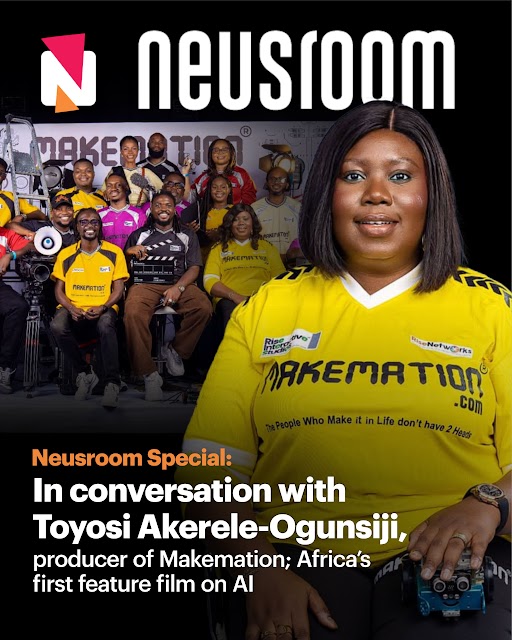
Neusroom Special: In conversation with Toyosi Akerele-Ogunsiji, Producer of Makemation; Africa’s first feature film on AI
Toyosi Akerele-Ogunsiji, the creator of Makemation; Africa’s 1st feature film on AI tells Neusroom’s Tomiwo Ojo why this important project on technology evolution comes wrapped in the irresistible package of storytelling, character, and cultural authenticity
Written by Tomiwo Ojo for Neusroom
May 31, 2025
There are many beautiful stories about the Nigerian tech ecosystem and all it has achieved, but it still seems rather elusive for the vast majority of the young people who live in many communities.
So Toyosi Akerele-Ogunsiji, a Forbes-recognised powerhouse, set out to create a narrative that could redefine our technological future with “Makemation,” Africa’s first feature film on artificial intelligence and emerging technologies.
The movie, which follows Zara Sodangi, a 17-year-old, poverty-stricken girl who overcomes gender discrimination, digital inequality, and other challenges to offer tech-based solutions to societal problems, comes at a time when Africa finds itself at a digital crossroads on how to take advantage of emerging technologies such as Artificial Intelligence.
I sat with Toyosi Akerele-Ogunsiji at the screening of Makemation for secondary school students in Lagos, and she explained why this important project on technology evolution comes wrapped in the irresistible package of storytelling, character, and cultural authenticity that makes viewers forget they’re actually learning something revolutionary.
“We don’t have any tech film. We don’t have a tech feature film made in Africa, made in Nigeria. This is the first,” Akerele-Ogunsiji explains with the confidence of someone accustomed to breaking ceilings.
While this is her first film-making endeavour, her resume reads like she has done it all: communications executive, social entrepreneur, human development expert, founder and CEO of Rise Networks, PHD fellow, and now a film-maker who intends to produce more tech-focused content.

Makemation Production Crew (Photo: Makemation)
But creating “Makemation” wasn’t simply about ticking another box. For Akerele-Ogunsiji, the mission is far more important: “I saw the need to tell an African, Nigerian story that exports our culture to the world, but also shows the best of Nigeria and Africa and how we’re using technology. Especially how young people are using technology to solve problems.”
It’s Africa’s time to contribute to the creation and production of technology around the world. And I did not want us to constantly be profiled as consumers of innovation.
She is credited with many aspects of the film, from production design to casting, and she told Neusroom that they had to build sets and entire conceptual frameworks from the ground up. “I watched at least 300 movies before I started making this movie. My KPI is not just making money, but to inspire everyone that ‘people who make it in life do not have two heads’, and I think I have achieved this because the feedback from the people who have seen it has been overwhelmingly positive.“
She also possesses an obsessive attention to detail, which she believes helped the movie achieve her dreams for it. “For my colleagues and teams whom I’ve worked with, they know that during Projects, particularly this Makemation Film, we must have and had various iterations of an idea until we get it right, I will review it till I’m confident that we’re near a kind of perfection that shows respect for our stakeholders. It’s excellence or nothing. We won’t compromise,” she admits without apology. “Many often wondered why I was such a stickler for going against the norm, why I always fussed about details, but now we’re all pleased and proud at the kinds of sterling reviews the film is receiving. For even the best ideas, execution reigns supreme, and the devil is in the details. Those tiny details that may have seemed hitherto were all essential to the film’s authenticity and impact I wanted it to have on our audiences around the world.” she recalls.

Toyosi Akerele-Oginsiji (Photo: Makemation)
If making any feature film is challenging, creating one centred on cutting-edge technology in a country like Nigeria presented a whole new category of obstacles.
“I’m still facing problems,” Akerele-Ogunsiji jokes about the challenges faced in making the movie. “First, because it’s a first of its kind, it’s a very novel story. It was very difficult to even sort of create the world around it. The production design alone required reimagining spaces that barely exist in Nigeria. That AI lab, for example, was created from scratch,” she reveals.
“It was also very difficult trying to sell the idea to people… because people are like, ‘it’s never been done before, right? So why do you want to be the first to do it?’“
At the centre of “Makemation” stands Zara Sodangi, played by Tomi Ojo, a character whose struggles mirror those of countless young African women navigating a landscape of limited resources and limitless obstacles. When asked if she relates to Zara, Akerele-Ogunsiji’s response is immediate: “Absolutely. In the most interesting and riveting ways, we created the world of Zara in the movie to draw attention to the real life impediments girls are facing in Tech and how young people are navigating their way in accessing technology education and skills in Nigeria and Africa”
In a tech ecosystem often dominated by privileged backgrounds and elite education, Zara’s story offers a counternarrative where innovation emerges not despite hardship but sometimes because of it. As Akerele-Ogunsiji puts it, the film shows “young people who don’t have privilege that they can become anything from anywhere. You can do big things from small places and how much you can succeed in life is not dependent on any individual. It’s right here in your heart.“

The cast and crew of Makemation with corporate leaders and Lagos’ Governor Sanwo-Olu at a Media Parley at the State House in Marina (Photo: Makemation)
The decision to focus on artificial intelligence was also deliberate, not because it is trending at the moment, but because of its transformative potential. “Of all the technologies of the 4th industrial revolution, artificial intelligence has the most transformative potential,” she explains. Yet, she knows that making it accessible is more important than recognising its potential, and this is where “Makemation” performs its most impressive bit of magic, translating complex technological concepts using the universal language of storytelling.
“One of the best ways to democratize access to anything is to simplify technical concepts like this one and put it in a film because young people love music, pop culture, and film,” Akerele-Ogunsiji notes. Instead of approaching AI education through traditional channels like introducing it as a course in the school curriculum, the film offers “a faster way of introducing young children to AI in a way that is very simplistic, very relatable, very cool, that then stimulates your curiosity and makes you go and begin to research more and decide to do more with AI.“
So far, the reception of Makemation has been excellent. It is a movie I particularly enjoyed, and I am yet to see a negative review anywhere. While Akerele-Ogunsiji initially anticipated strong reactions from younger viewers who are its target audience, the film has found an unexpectedly universal audience.
“For every single human being who’s seen Makemation, it’s been nothing but high praise and excitement. People love the film,” she shares with pride. “We were afraid about how people were going to accept our baby. But it’s been such a beautiful experience just seeing people rave about it, and I’m talking about children, parents, teenagers, young adults, old people, grandparents, techies, non-techies.”

Iyinoluwa Aboyeji in a scene of the movie (Photo: Makemation)
For Akerele-Ogunsiji, “Makemation” isn’t merely a standalone project but the beginning of a larger ecosystem. Construction will soon begin on the Makemation Campus in Lagos, and shooting for a “Makemation” series is set to commence ahead of its 2026 air date. These expansions suggest a vision that extends far beyond traditional filmmaking—one that sees “Makemation” not just as content but as a catalyst for a new kind of technological engagement across the continent, starting from Nigeria.
As the credits roll on “Makemation,” viewers are left with more than just the satisfaction of a story well-told. They carry with them a new algorithm for possibility—one that computes innovation not as a function of privilege or geography, but of vision, persistence, and the courage to create worlds that don’t yet exist.
“I personally believe that Makemation is the turning point for the adoption of technology and artificial intelligence, in particular for us in this part of the world,” Akerele-Ogunsiji states with conviction.